 Log in



Your local library!


472 likes, 47 retweets
Just a reminder that Nick Robinson sucks. Fired from Polygon for sexual misconduct.



The fifth anniversary of the passing of Google Reader went largely unremarked in most circles, but there was some coverage on Techdirt and other sites (Wired even called for a revival of RSS).
RSS largely died with Google Reader; development of the RSS standard (and the Atom standard that replaced it) had petered out years before, and aside from a brief surge in new apps in 2013, we haven't seen a new feed reader service in years.
Nevertheless, a lot of us still use RSS on a regular basis, and I was wondering just how many people are still using RSS as much as they did 5 years ago.
I'll go first.
I am still using BazQux Reader, the app I switched to from Google Reader 5 years ago (in fact, I had to pay the annual subscription on 2 July). I still have over two thousand RSS feeds in Bazqux, but they are not half as useful as they used to be.
I checked with Feedly* and discovered 843 of the feeds I follow are now dead because either the site went away or moved its RSS feed in an update, and another 621 feeds are inactive (new posts are only published a few times a year).
All of those feeds used to be alive with at least weekly updates, but in the past five years most of their owners have moved from owning their own platform to being, as Mike Masnick pointed out, trapped in one or another social media silo (Facebook, Twitter, etc).
How about you? Do you still RSS?
* If you use Feedly, you can check how many dead feeds you follow by opening the "organize" menu.
image by Phil Denton
You just finished reading Do You Still RSS? which was published on The Digital Reader.


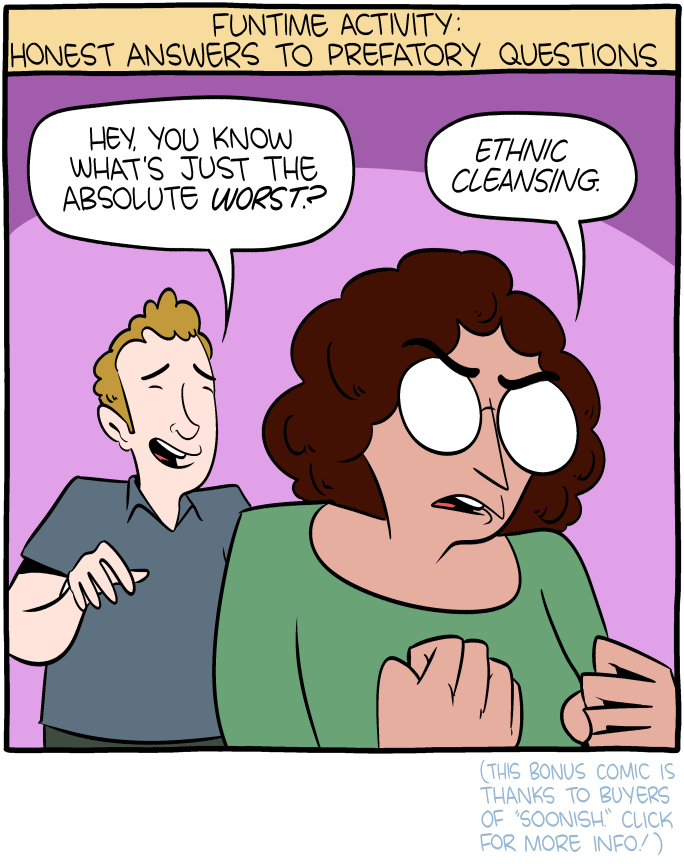
Click here to go see the bonus panel!
Hovertext:
Interestingly, trying to come up with a linguistic opposite to 'ethnic cleansing' ALSO sounds racist.
New comic!
Today's News:

Red Button mashing provided by SMBC RSS Plus. If you consume this comic through RSS, you may want to support Zach's Patreon for like a $1 or something at least especially since this is scraping the site deeper than provided.
Indiscriminate befouling isn't really in the spirit of the hovertext but I still really like the combination of those words.
I guess Indiscriminate Healing, but that just sounds like a very RNG based cleric spell.
I guess Indiscriminate Healing, but that just sounds like a very RNG based cleric spell.


Enlarge / The Goldman Sachs bank logo is seen reflected on the screen of a mobile phone in this photo illustration on November 15, 2017. (credit: Jaap Arriens/NurPhoto via Getty Images)

One-shot cures for diseases are not great for business—more specifically, they’re bad for longterm profits—Goldman Sachs analysts noted in an April 10 report for biotech clients, first reported by CNBC.
The investment banks’ report, titled “The Genome Revolution,” asks clients the touchy question: “Is curing patients a sustainable business model?” The answer may be “no,” according to follow-up information provided.
Analyst Salveen Richter and colleagues laid it out:
The potential to deliver “one shot cures” is one of the most attractive aspects of gene therapy, genetically engineered cell therapy, and gene editing. However, such treatments offer a very different outlook with regard to recurring revenue versus chronic therapies... While this proposition carries tremendous value for patients and society, it could represent a challenge for genome medicine developers looking for sustained cash flow.
For a real-world example, they pointed to Gilead Sciences, which markets treatments for hepatitis C that have cure rates exceeding 90 percent. In 2015, the company’s hepatitis C treatment sales peaked at $12.5 billion. But as more people were cured and there were fewer infected individuals to spread the disease, sales began to languish. Goldman Sachs analysts estimate that the treatments will bring in less than $4 billion this year.
“[Gilead]’s rapid rise and fall of its hepatitis C franchise highlights one of the dynamics of an effective drug that permanently cures a disease, resulting in a gradual exhaustion of the prevalent pool of patients,” the analysts wrote. The report noted that diseases such as common cancers—where the “incident pool remains stable”—are less risky for business.
To get around the sustainability issue overall, the report suggests that biotech companies focus on diseases or conditions that seem to be becoming more common and/or are already high-incidence. It also suggests that companies be innovative and constantly expanding their portfolio of treatments. This can “offset the declining revenue trajectory of prior assets." Lastly, it hints that, as such cures come to fruition, they could open up more investment opportunities in treatments for “disease of aging.”
Ars reached out to Goldman Sachs, which confirmed the content of the report but declined to comment.
This post has been updated.
I have worked in orphan drug status pharma companies for most of my career and this attitude really bums me out. Late stage capitalism stamps out progress in the pursuit of profits to such a depressing degree.
I truly hope this isn't indicative of an attitude shift in investment firms. Companies who are researching trans-formative and life saving drugs rely so heavily on investment to take a possible treatment or cure to a full scale deliverable drug.
I truly hope this isn't indicative of an attitude shift in investment firms. Companies who are researching trans-formative and life saving drugs rely so heavily on investment to take a possible treatment or cure to a full scale deliverable drug.
1 public comment

I really fucking hate capitalism. They are correct only in the specific outlook of maximizing profits for individual companies. Once you take the larger increase in value to society that is created by those people who will no longer suffer and die from a now preventable disease, then the equation breaks down. Regardless, fuck those guys.
Somerville, MA
Next Page of Stories